0

TECHNOLOGY

  • WHICH UNIQUE SUZUKI TECHNOLOGY SAVES FUEL?

    Lean Burn Control 

    Suzuki Marine Lean Burn Technology delivers exceptional outboard fuel efficiency without compromising power or performance. This advanced fuel-saving system continuously monitors operating conditions and supplies the precise air-to-fuel mixture required, particularly at cruising speeds.

    Available across a wide range of Suzuki four-stroke outboard motors, Lean Burn Technology helps reduce fuel consumption, lower boating costs and extend your cruising range. Whether you need a reliable outboard motor for fishing, leisure boating or commercial use, Suzuki offers economical marine engines engineered for smooth, dependable performance.

    LEARN MORE

  • WHY DOES SUZUKI USE A SELF ADJUSTING TIMING CHAIN?

    Self Adjusting Timing Chain

    The Suzuki Self Adjusting Timing Chain is designed to deliver long lasting reliability with minimal maintenance. Unlike a traditional timing belt, the timing chain is lubricated by the engine oil and automatically maintains the correct tension during operation.

    This advanced Suzuki outboard technology reduces the need for routine timing belt replacement while supporting smooth, dependable engine performance. It provides Suzuki boat owners with greater peace of mind, lower maintenance requirements and proven durability on the water.

    Available on selected Suzuki four stroke outboard motors, the Self Adjusting Timing Chain is another reason why Suzuki outboards are trusted for recreational boating, fishing and commercial marine applications.

    Self Adjusting Timing Chain Image


    LEARN MORE

  • WHAT SUZUKI TECHNOLOGY HELPS PROTECT YOUR OUTBOARD FROM CORROSION?

    Anti Corrosion

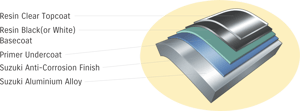
    The Suzuki Anti Corrosion Finish provides advanced protection for Suzuki outboard motors operating in harsh marine environments. This specialised multi layer coating creates a strong barrier between the aluminium exterior and corrosive elements such as saltwater, moisture and UV exposure.

    Designed to improve durability and extend engine life, Suzuki’s corrosion protection helps keep your outboard motor performing reliably and looking its best. Regular cleaning and correct maintenance, combined with the Suzuki Anti Corrosion Finish, provide added confidence for both freshwater and saltwater boating.

    Corrosion Protection Image


    LEARN MORE

  • WHAT HELPS YOUR SUZUKI OUTBOARD DELIVER POWER ACROSS THE REV RANGE?

    Multi Stage Induction

    Suzuki Multi Stage Induction is an advanced engine technology designed to deliver strong performance across the entire operating range. The system uses different intake pathways to optimise airflow according to engine speed.

    At lower revs, a longer intake path helps improve low end torque and acceleration. At higher revs, the system switches to a shorter intake path, allowing more air into the engine for increased power and responsive performance.

    Available on selected Suzuki four stroke outboard motors, Multi Stage Induction provides smooth acceleration, dependable power and improved engine efficiency. Whether cruising, carrying heavy loads or accelerating onto the plane, Suzuki outboard technology delivers the performance boaters can rely on.


    LEARN MORE
  • WHAT HELPS YOUR SUZUKI DELIVER STRONGER LOW AND MID RANGE TORQUE?

    Suzuki Variable Valve Timing is an advanced engine technology designed to deliver stronger acceleration, improved torque and smooth outboard performance across a wide operating range.

    The system automatically adjusts the timing of the intake valves according to engine speed. This helps optimise airflow and combustion, providing increased low and mid range torque when accelerating while maintaining responsive power at higher speeds.

    Available on selected Suzuki four stroke outboard motors, Variable Valve Timing supports efficient performance whether you are getting onto the plane, cruising offshore or carrying heavier loads.

  • HOW DO YOU KNOW IF THERE IS WATER IN YOUR FUEL?

    Water Detecting System

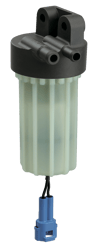
    The Suzuki Water Detecting System helps protect your outboard motor by monitoring the fuel supply for the presence of water. If water is detected in the fuel, the system alerts the boat operator so the problem can be addressed before it affects engine performance or causes potential damage.

    Clean fuel is essential for reliable operation, smooth performance and long engine life. Available on selected Suzuki four stroke outboard motors, this intelligent warning system provides added protection and greater peace of mind on the water.

    Water Detecting Device Image


  • WHAT ARE THE BENEFITS OF SUZUKI’S DUAL INJECTOR TECHNOLOGY?

    Suzuki Dual Injector Technology is an advanced fuel injection system designed to deliver greater power, improved combustion and responsive outboard performance.

    The system uses two fuel injectors per cylinder to deliver a precise amount of fuel into the combustion chamber. This creates a finer fuel mixture, helping the engine produce efficient combustion, strong acceleration and smooth power across the operating range.

    Available on selected Suzuki four stroke outboard motors, Dual Injector Technology supports powerful performance while maintaining the fuel efficiency and reliability expected from Suzuki.


  • HOW DOES SUZUKI’S OFFSET DRIVESHAFT IMPROVE OUTBOARD DESIGN?

    Offset Drive Shaft

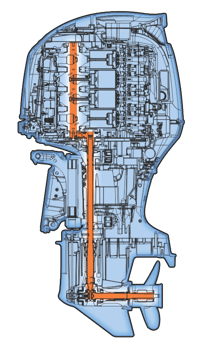
    Suzuki’s Offset Driveshaft positions the engine powerhead farther forward, moving the outboard motor’s centre of gravity closer to the boat. This compact design helps reduce vibration and delivers stable steering, giving you a smoother, more comfortable experience on the water.

    Offset Drive Shaft Image


  • HOW DOES SUZUKI’S MULTI-STAGE INDUCTION IMPROVE OUTBOARD PERFORMANCE?

    Multi Stage Induction

    Suzuki’s Multi Stage Induction technology adjusts the length of the intake manifold pipes to control airflow into the engine. Longer pipes help improve combustion efficiency and low speed torque, while shorter pipes allow more air in for stronger high speed performance. The result is responsive power across a wide range of engine speeds..

NEW SUZUKI

  • WHAT DO I GET WITH MY NEW SUZUKI?

    What’s in the Box?
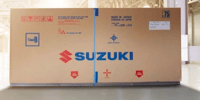
    When you purchase your Suzuki outboard motor, you'll get the Full Package Price
    With the DF140 for example this awesome deal includes:
    - Your new Suzuki outboard
    - Multi-function gauge kit
    - Stainless-steel propeller(s)
    - Binnacle control box
    - Main switch panel
    - All the sensors, wires, and cables you need
    - Ecstar outboard oil
    - Exclusive Suzuki accessories like caps, floatable keyrings, stickers, and more.
     
    What is in the box_Suzuki_outboards
    LEARN MORE


  • WHAT SHOULD I DO BEFORE USING MY SUZUKI OUTBOARD FOR THE FIRST TIME?

    What's the break-in procedure for my new outboard?
    • Break-in consists of maintaining lower RPM levels and varying the RPM’s for the first 10 hours of use. The break-in procedure is included in your owner’s manual. Correct operation during the break-in period will prolong the life of your new outboard and will ensure optimum performance. Break-in should be done under a load (on your boat, not at home in a container of water).

    What do I need to do before using my new outboard?
    • Engine oil must be added prior to use. The engine oil is drained by the factory prior to shipping. When your new outboard arrives, you simply add engine oil (amount and type are shown on page 1 of the manual). The lower unit gear lube is pre-filled from the factory. No assembly is required. Even the propeller is pre-installed for your convenience.
    • If you have purchased an electric start model, your outboard will include battery leads pre-installed from the factory (battery not included). You simply connect the battery leads to your battery. The Warranty conditions require that this work be carried out by an Authorised Suzuki Dealer.
    • Read the owner’s manual carefully prior to operation. The owner’s manual contains important information regarding the break-in period, safety and proper use of your outboard engine.

    May I start the engine out of water?
    • Never start your engine out of the water unless you are using an external lower-unit flushing adapter, commonly known as “ear muffs” designed for your type of outboard motor (not the integral Freshwater Flush Adapter found on some engines) to provide cooling water from a garden hose. Otherwise, you could damage or seize the engine. Operate at no more than an advanced idle with good water pressure. Never put the engine in gear. Never leave a running engine unattended.
  • HOW DO I BREAK IN MY NEW SUZUKI OUTBOARD?

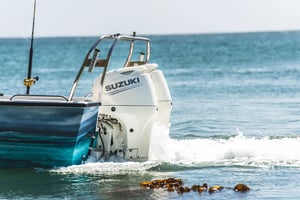
    Your new Suzuki outboard requires a 10-hour break-in period to help engine components bed in correctly, supporting long-term performance and reliability.

    Quick guide: During hours 1–2, warm the engine properly and keep operation mostly below 3,000 RPM. In hour 3, you can increase to around 4,000 RPM while still avoiding full throttle. During hours 4–10, normal operation can gradually begin, with occasional full-throttle runs of no more than five minutes at a time.

    Use this period to get to know your boat and Suzuki, ideally with the boat loaded as it would be during normal use. Regularly check your fuel and battery connections, propeller nut, transom bolts and brackets.

    Always refer to your Suzuki Owner’s Manual for the complete break-in procedure specific to your outboard model.
     

    100 Outboard.jpg

    LEARN MORE

  • WHICH SUZUKI STEALTH LINE OUTBOARD MODELS ARE AVAILABLE IN SOUTH AFRICA?

    - DF115B / DF115BG | DF140B / DF140BG

    - DF200A / DF200AP

    - DF250S

    - DF300AP

    - DF350AMD 

    LEARN MORE

  • WHO MAKES SUZUKI OUTBOARDS?

    Suzuki outboard motors are manufactured in Japan and Thailand. Mid to large Suzuki outboards are made at the Kosai Plant in Japan, while smaller models are produced by Thai Suzuki.

    LEARN MORE

  • MOTOR SPECIFICATIONS

    What is the smallest Suzuki outboard that offers electric start and remote control?
    • At the moment, an electric start is available starting with the 2-stroke 40hp remote control model (DT40WRL). On the 4-stroke range, models from 15hp and more have an electric start model (DF15ATL).
    • A “remote control” outboard is one that is equipped with the remote throttle, shift and steering controls. This allows the user to operate the outboard from a remote location in relation to the engine (throttle/shift and/or steering).


    What is the CARB emissions rating for new Suzuki outboards?

    • The California Air Resources Board (CARB) requires manufacturers to apply environmental emission rating labels to all new outboard engines which began with the model year 2001. The Emission label keeps consumers informed when making a purchase decision. California emission regulations are stricter than EPA regulations.
    • Every Suzuki four-stroke outboard sold today meets or exceeds all EPA emissions standards and has a CARB 3-Star Ultra Low Emissions rating
  • TRANSPORT AND STORAGE

    Can I use the Tilt Support Lever for transporting my Suzuki outboard?
    • No. The Tilt Support Lever is to be used only for storage purposes. The Tilt Support Lever was not designed to withstand the strain of transport and could break causing damage to the Tlit Support Lever and/or other bracket components. There are many aftermarket companies that provide “transom savers” that can offer a solution for your transportation needs. Please make sure that whatever aftermarket component you use is designed to work specifically with your Suzuki outboard. You can review “Storage and Transportation” instruction in your Owner’s Manual. You can find this information in the Maintenance section.

    Can a 4-stroke be laid on its side during transport and storage?
    • Yes. If necessary, outboards up to 20hp can be laid on its side but it must be laid on the proper side. Your outboard includes a picture (decal) on the engine itself indicating which direction the engine can be laid. Please see owner’s manual for additional information on transporting and storage of your outboard.
  • TROUBLESHOOTING

    What do the warning buzzer and subsequent flashing light mean?
    • You should read your Owner’s Manual before operating your Suzuki Outboard. It will explain various warnings you might encounter during operation. The monitor gauge will illuminate why the warning buzzer has sounded. If the warning buzzer is indicating a problem with oil or overheating, it will also be accompanied by a reduction in maximum RPM. The buzzer will sound when the engine is started. The warning system will sound and the oil light will illuminate after the first 20 hours of operation – it is time for the first oil change. This process will repeat after another 80 hours of operation and then again after every 100 hours of operation. Conditions like low oil and overheating can seriously damage your engine. If you are unable to determine why the buzzer has sounded, you should check with your authorized Suzuki Marine dealer before continued operation.
  • AFTER-SALES SERVICE AND PARTS

    Can I get parts for a very old Suzuki outboard?
    • Suzuki will do its best to get you the parts you need, but the older the motor, the less likely it is that parts will be readily available. Availability, to a certain extent, depends on how many models the specific part was used for and the number of years your model was produced. You’ll find the manufacturer’s identification tag on the motor mount bracket, generally on the starboard (right) side of the bracket. Be sure to take down all the information on the model designator, including all prefixes and suffixes and show it to your Suzuki dealer. We’ll do everything possible to help you get new parts for your older Suzuki outboard.

    I keep my boat in the water and am concerned about flushing it regularly. What can I do?
    • Suzuki outboards are equipped with freshwater flush ports (all models except DF2.5, 9.9). A simple garden hose attachment makes it easy to clean the cooling system of saltwater and impurities. In fact, DF70, 80, 90, 150, 175, 200A, 250 and 300 have dual flushing ports. One is located on the backside of the down housing and the second is located on the front panel to provide easy access and no excuses.

    Is the timing chain really maintenance-free?
    • Yes, it is! The timing chain is located below the powerhead where it runs in a continual oil bath for dependable and quiet operation. With Suzuki’s exclusive automatic hydraulic chain tensioner, you can focus on boating and having a good time. (DF40, 50, 70, 80, 90, 100, 115, 140, 150, 175, 200, 225, 250, 250SS, 300).
  • HOW TO MEASURE THE SHAFT LENGTH

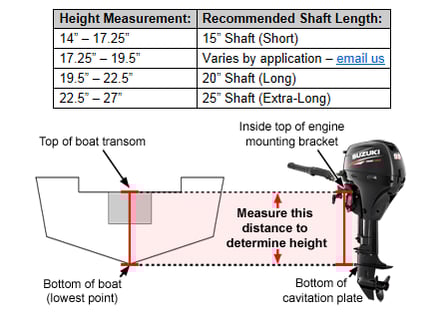
    If mounting directly to a boat transom: Measure from the top of the transom down to the bottom of the hull or keel (lowest point). Measure the area of the transom directly where the engine will be mounted. See diagram below.


    If using an auxiliary mounting bracket: With the bracket in the down position, measure from the top of the bracket’s mounting surface down to the bottom of the hull or keel (where the engine is to be mounted).

    Tip: For most auxiliary applications, it is possible to use a longer shaft length than what is called for, provided there is sufficient clearance when the engine is in the up position. This can be especially useful in heavy seas.


    If measuring an existing outboard: Measure from the inside top of mounting bracket down to anti-cavitation plate above propeller (this is the largest plate/fin directly above the propeller). See diagram below.

    4-stroke-oil

  • ARE SUZUKI OUTBOARDS SALTWATER RATED?

    Yes. Suzuki utilizes a unique four-part system to fight the effects of saltwater corrosion, beginning with the use of high-grade aluminium alloy for metal castings. A thorough chemical cleaning process prepares the casting ensuring superior adhesion of surface coatings.


    The parts are then submerged in an electrified bath of chromium oxide. The bath changes the make-up of the casting’s surface and creates an invisible barrier that becomes integrated as part of the casting.
    Finally, an extremely hard and resilient epoxy resin primer is baked on, and a top coat of Melamine resin marine grade paint is applied to the castings. Suzuki’s casting and finishing process protects the outboard and effectively seals out saltwater.


    Suzuki’s anti-corrosion system does not stop at casting construction and finishing. All Suzuki outboards feature sacrificial zinc anodes strategically placed internally and externally. These replaceable anodes fight corrosion and preserve overall engine integrity.

    Additionally, the use of specialized marine-grade stainless steel and Dacromate coated hardware for key components ensure superior corrosion protection in even the harshest environments.


  • WHAT IS THE CARB EMISSIONS RATING FOR SUZUKI OUTBOARDS?

    The California Air Resources Board (CARB) uses emissions labels to help buyers compare outboard engines. Suzuki four-stroke outboards meet EPA emissions standards, and qualifying models carry a CARB 3-Star Ultra Low Emission rating. Check the rating on the specific model you’re considering.

    LEARN MORE

PRE OWNED

  • OUTBOARD YEAR MODEL & SERIAL NUMBER

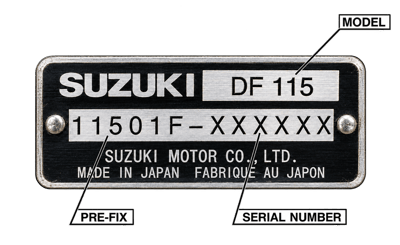
    Identifying Your Suzuki Outboard Model, Model Year and Serial Number

    Knowing your Suzuki outboard model, model year and serial number is essential when booking a service, ordering genuine Suzuki parts, checking warranty information or confirming the correct specifications for your engine.

    The identification label is generally located on the outboard motor’s mounting bracket. It displays important information such as the Suzuki model number and unique engine serial number. The model number identifies the outboard’s horsepower, starting system, control type and shaft length, while the serial number allows an authorised Suzuki Marine dealer to confirm its production details and model year.

    Always provide the complete model and serial number when requesting Suzuki outboard parts, maintenance or technical support. If the identification label is missing or difficult to read, contact an authorised Suzuki Marine South Africa dealer for assistance.

    Suzuki_Tag


  • THE LIFESPAN OF A SUZUKI OUTBOARD

    A well-maintained Suzuki outboard motor can deliver years of reliable boating, with lifespan depending on servicing, usage and operating conditions.
    Discover how regular outboard maintenance, fresh water flushing and proper storage can help extend your Suzuki engine’s life.

    LEARN MORE

  • TROUBLESHOOTING

    What do the warning buzzer and subsequent flashing light mean?
    • You should read your Owner’s Manual before operating your Suzuki Outboard. It will explain various warnings you might encounter during operation. The monitor gauge will illuminate why the warning buzzer has sounded. If the warning buzzer is indicating a problem with oil or overheating, it will also be accompanied by a reduction in maximum RPM. The buzzer will sound when the engine is started. The warning system will sound and the oil light will illuminate after the first 20 hours of operation – it is time for the first oil change. This process will repeat after another 80 hours of operation and then again after every 100 hours of operation. Conditions like low oil and overheating can seriously damage your engine. If you are unable to determine why the buzzer has sounded, you should check with your authorized Suzuki Marine dealer before continued operation.

MAINTENANCE

  • TROUBLESHOOTING

    What do the warning buzzer and subsequent flashing light mean?
    • You should read your Owner’s Manual before operating your Suzuki Outboard. It will explain various warnings you might encounter during operation. The monitor gauge will illuminate why the warning buzzer has sounded. If the warning buzzer is indicating a problem with oil or overheating, it will also be accompanied by a reduction in maximum RPM. The buzzer will sound when the engine is started. The warning system will sound and the oil light will illuminate after the first 20 hours of operation – it is time for the first oil change. This process will repeat after another 80 hours of operation and then again after every 100 hours of operation. Conditions like low oil and overheating can seriously damage your engine. If you are unable to determine why the buzzer has sounded, you should check with your authorized Suzuki Marine dealer before continued operation.
  • AFTER-SALES SERVICE AND PARTS

    Can I get parts for a very old Suzuki outboard?
    • Suzuki will do its best to get you the parts you need, but the older the motor, the less likely it is that parts will be readily available. Availability, to a certain extent, depends on how many models the specific part was used for and the number of years your model was produced. You’ll find the manufacturer’s identification tag on the motor mount bracket, generally on the starboard (right) side of the bracket. Be sure to take down all the information on the model designator, including all prefixes and suffixes and show it to your Suzuki dealer. We’ll do everything possible to help you get new parts for your older Suzuki outboard.

    I keep my boat in the water and am concerned about flushing it regularly. What can I do?
    • Suzuki outboards are equipped with freshwater flush ports (all models except DF2.5, 9.9). A simple garden hose attachment makes it easy to clean the cooling system of saltwater and impurities. In fact, DF70, 80, 90, 150, 175, 200A, 250 and 300 have dual flushing ports. One is located on the backside of the down housing and the second is located on the front panel to provide easy access and no excuses.

    Is the timing chain really maintenance-free?
    • Yes, it is! The timing chain is located below the powerhead where it runs in a continual oil bath for dependable and quiet operation. With Suzuki’s exclusive automatic hydraulic chain tensioner, you can focus on boating and having a good time. (DF40, 50, 70, 80, 90, 100, 115, 140, 150, 175, 200, 225, 250, 250SS, 300).
  • OUTBOARD YEAR MODEL & SERIAL NUMBER

    Lorem ipsum dolor sit amet, consectetur adipiscing elit. Donec at tempus leo. Integer dui arcu, sagittis dignissim libero vitae, elementum tempor justo. Aliquam faucibus congue odio, malesuada varius erat aliquet sit amet. Nulla id finibus purus, vel pulvinar purus. Maecenas ornare, mi vel rutrum feugiat, arcu eros tincidunt nulla, nec rutrum velit magna sit amet turpis. Suspendisse potenti. Vestibulum ullamcorper massa in felis feugiat, et luctus turpis dignissim. Praesent pretium, turpis ac euismod vehicula, ante felis tristique libero, in viverra eros nisi quis magna.

  • HOW TO BREAK IN YOUR SUZUKI

    Breaking In Your Suzuki Outboard

    Your new Suzuki outboard requires a 10-hour break-in period to help engine components bed in correctly, supporting long-term performance and reliability.

    Quick guide: During hours 1–2, warm the engine properly and keep operation mostly below 3,000 RPM. In hour 3, you can increase to around 4,000 RPM while still avoiding full throttle. During hours 4–10, normal operation can gradually begin, with occasional full-throttle runs of no more than five minutes at a time.

    Use this period to get to know your boat and Suzuki, ideally with the boat loaded as it would be during normal use. Regularly check your fuel and battery connections, propeller nut, transom bolts and brackets.

    Always refer to your Suzuki Owner’s Manual for the complete break-in procedure specific to your outboard model.

     

    100 Outboard.jpg

    LEARN MORE

  • MOTOR SPECIFICATIONS

    What is the smallest Suzuki outboard that offers electric start and remote control?
    • At the moment, an electric start is available starting with the 2-stroke 40hp remote control model (DT40WRL). On the 4-stroke range, models from 15hp and more have an electric start model (DF15ATL).
    • A “remote control” outboard is one that is equipped with the remote throttle, shift and steering controls. This allows the user to operate the outboard from a remote location in relation to the engine (throttle/shift and/or steering).

    Are Suzuki outboards salt-water rated?
    • Yes. Suzuki utilizes a unique four-part system to fight the effects of saltwater corrosion, beginning with the use of high-grade aluminium alloy for metal castings. A thorough chemical cleaning process prepares the casting ensuring superior adhesion of surface coatings.
    • The parts are then submerged in an electrified bath of chromium oxide. The bath changes the make-up of the casting’s surface and creates an invisible barrier that becomes integrated as part of the casting.
    • Finally, an extremely hard and resilient epoxy resin primer is baked on, and a top coat of Melamine resin marine grade paint is applied to the castings. Suzuki’s casting and finishing process protects the outboard and effectively seals out saltwater.
    • Suzuki’s anti-corrosion system does not stop at casting construction and finishing. All Suzuki outboards feature sacrificial zinc anodes strategically placed internally and externally. These replaceable anodes fight corrosion and preserve overall engine integrity. Additionally, the use of specialized marine-grade stainless steel and Dacromate coated hardware for key components ensure superior corrosion protection in even the harshest environments.


    How do I measure the shaft length?

    • If mounting directly to a boat transom: Measure from the top of the transom down to the bottom of the hull or keel (lowest point). Measure the area of the transom directly where the engine will be mounted. See diagram below.
    • If using an auxiliary mounting bracket: With the bracket in the down position, measure from the top of the bracket’s mounting surface down to the bottom of the hull or keel (where the engine is to be mounted). Tip: For most auxiliary applications, it is possible to use a longer shaft length than what is called for, provided there is sufficient clearance when the engine is in the up position. This can be especially useful in heavy seas.
    • If measuring an existing outboard: Measure from the inside top of mounting bracket down to anti-cavitation plate above propeller (this is the largest plate/fin directly above the propeller). See diagram below.

    4-stroke-oil


    What is the CARB emissions rating for new Suzuki outboards?

    • The California Air Resources Board (CARB) requires manufacturers to apply environmental emission rating labels to all new outboard engines which began with the model year 2001. The Emission label keeps consumers informed when making a purchase decision. California emission regulations are stricter than EPA regulations.
    • Every Suzuki four-stroke outboard sold today meets or exceeds all EPA emissions standards and has a CARB 3-Star Ultra Low Emissions rating
  • FIRST USE PROCEDURES

    What's the break-in procedure for my new outboard?
    • Break-in consists of maintaining lower RPM levels and varying the RPM’s for the first 10 hours of use. The break-in procedure is included in your owner’s manual. Correct operation during the break-in period will prolong the life of your new outboard and will ensure optimum performance. Break-in should be done under a load (on your boat, not at home in a container of water).

    What do I need to do before using my new outboard?
    • Engine oil must be added prior to use. The engine oil is drained by the factory prior to shipping. When your new outboard arrives, you simply add engine oil (amount and type are shown on page 1 of the manual). The lower unit gear lube is pre-filled from the factory. No assembly is required. Even the propeller is pre-installed for your convenience.
    • If you have purchased an electric start model, your outboard will include battery leads pre-installed from the factory (battery not included). You simply connect the battery leads to your battery. The Warranty conditions require that this work be carried out by an Authorised Suzuki Dealer.
    • Read the owner’s manual carefully prior to operation. The owner’s manual contains important information regarding the break-in period, safety and proper use of your outboard engine.

    May I start the engine out of water?
    • Never start your engine out of the water unless you are using an external lower-unit flushing adapter, commonly known as “ear muffs” designed for your type of outboard motor (not the integral Freshwater Flush Adapter found on some engines) to provide cooling water from a garden hose. Otherwise, you could damage or seize the engine. Operate at no more than an advanced idle with good water pressure. Never put the engine in gear. Never leave a running engine unattended.
  • TRANSPORT AND STORAGE

    Can I use the Tilt Support Lever for transporting my Suzuki outboard?
    • No. The Tilt Support Lever is to be used only for storage purposes. The Tilt Support Lever was not designed to withstand the strain of transport and could break causing damage to the Tlit Support Lever and/or other bracket components. There are many aftermarket companies that provide “transom savers” that can offer a solution for your transportation needs. Please make sure that whatever aftermarket component you use is designed to work specifically with your Suzuki outboard. You can review “Storage and Transportation” instruction in your Owner’s Manual. You can find this information in the Maintenance section.

    Can a 4-stroke be laid on its side during transport and storage?
    • Yes. If necessary, outboards up to 20hp can be laid on its side but it must be laid on the proper side. Your outboard includes a picture (decal) on the engine itself indicating which direction the engine can be laid. Please see owner’s manual for additional information on transporting and storage of your outboard.

What is the Self-Adjusting Timing Chain?

Suzuki’s self-adjusting timing chain maintains the correct tension automatically, helping reduce maintenance and support reliable outboard performance.


How to Check the Oil in Your Suzuki Outboard?

Regularly checking your Suzuki outboard’s engine oil is a simple way to help keep it running smoothly.


What is Suzuki Anti- Corrosion Finish 

Suzuki’s Anti-Corrosion Finish is a protective coating that helps shield your outboard from corrosion caused by saltwater and harsh marine conditions.